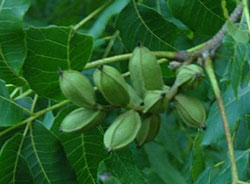
A favorite in late fall. Easy to grow, selected for northern climates, need 2 for cross pollinization. All cultivars well suited for zones 5 to 6. Native to North America growing from Mexico to Minnesota. Historically, pecans were planted by the Native Americans along waterways. While not all pecans are created equal the trees themselves have evolved and been bred to adapt to different climates and weather conditions. For example, Northern pecan cultivars have been adapted to shorter growing seasons. Trees are selected based on disease resistance and pest resistance.
For nut production, pecans must be pollinated by the cultivar's corresponding pollinator type (Type 1 or Type 2).
Avalon - Highly regarded, modern Type I pecan cultivar released by the University of Georgia (UGA) in 2016. It was specifically bred to solve a massive problem for Southern growers: providing the premium nut size and quality of the popular 'Desirable' variety, but with elite, breakthrough resistance to pecan scab. Large, averaging 46 to 47 nuts per pound. High meat percentage, yielding 53% to 54% kernel.
Large available
Colby - Is a historic, cold-hardy northern cultivar discovered in Illinois. This vigorous, fast-growing tree features a strong wood structure that easily withstands heavy northern wind, ice, and snow. It acts as a Type II pollinator, producing medium-sized, thin-shelled nuts that average 72 per pound with a 45% kernel yield. Ripening early in late September, its rich, buttery kernels are prized for baking, making it ideal for backyard orchards in USDA Zones 5–9.
XL available
Creek - fast-growing, highly productive cultivar released by the in 1996. Exceptional for its robust scab resistance, it thrives in humid environments across USDA Zones 6–9. This Type I pollinator is uniquely shade-tolerant, making it ideal for dense high-density planting. It bears heavily at a young age, producing long, elliptical, medium-thin shelled nuts averaging 54 per pound with a 48% kernel yield that ripens early in October.
Large available
Hark - Pecan scab resistant. Produces rounded extra large thin shelled pecan nuts. 61 nuts/lb and 56% kernel. Pecans grow in clusters of three. Cold Hardy. Type 1
Small and Medium available
Lakota - High-yielding, exceptionally vigorous hybrid cultivar released by the USDA in 2007. Thriving in USDA Zones 6–9, this Type II pollinator features outstanding tree strength and elite, low-maintenance pecan scab resistance. It produces teardrop-shaped, thin-shelled nuts that average 59 per pound with an excellent 58% to 62% kernel yield. Maturing early in late September, its cream-to-golden halves are premium quality
Large available
Mandan- Nuts ripen very early. This cultivar also has excellent pest and disease resistance. Nuts are very large for a northern variety and will easily crack out full halves. Approx. 53 nuts per pound. 60% kernel/shell ratio. Trees leaf out late, have an upright growth pattern with strong limbs and a good structure. Type 1
Medium available
Peruque - Cold-hardy northern cultivar from Missouri. This highly productive Type I pollinator bears sweet, premium-quality golden kernels at an early age. It features an outstanding 60% kernel yield inside paper-thin shells, averaging 80 to 95 nuts per pound. It ripens early in mid-September.
XL available
Peterson 3 - A rare, ultra-cold-hardy northern pecan cultivar selected for its short-season. Well-adapted to shorter northern summers, this tree exhibits excellent structural strength against winter ice and wind. It reliably produces high-quality, flavorful nuts that mature early before extreme autumn freezes set in.
Small, Medium and Large
Peterson 4 - (often called the P-4 pecan) is a rare, ultra-northern selection explicitly bred to withstand short growing seasons. Originating from the Bill Theisenhaus collection, this cold-hardy cultivar thrives in northern zones where typical varieties fail. It produces small, flavorful nuts with high oil content. Crucially, the shucks split remarkably early in autumn, protecting the crop from early freezes.
Small and Medium available
Pounds - Discovered by Leon Pounds in Gentryville Indiana around 1983. Likely a Major Seedling. Vetted by Jerry Lehman in Terra Haute Indiana. Heavy producer of medium sized nuts. Type 1.
XL available
Posey - A reliable, historic northern cultivar discovered in Indiana in 1911. Ideal for home growers, this beautiful landscape tree features excellent pecan scab resistance and lush foliage. As a Type II pollinator, it produces large, distinctly flattened nuts averaging 68 per pound. Maturing early in late September, its rich, buttery kernels are prized for local and backyard consumption
Small and Medium available
Tom - highly prolific, modern cultivar released by the University of Georgia in 2014. Exceptional for home orchards in USDA Zones 6–9, this Type I pollinator boasts outstanding resistance to pecan scab, black aphids, and scorch mites. It bears early, consistent crops of premium, unspeckled golden halves averaging 58 nuts per pound with a high 55% kernel yield
XL available
Whiddon - A highly productive cultivar bred from a Pawnee and Desirable cross by the University of Georgia. Thriving across USDA Zones 6–9, this early bearing, reliable Type I pollinator features superior pecan scab resistance and thick protective shells that deter bird damage. It produces exceptionally large, oblong nuts averaging 40 per pound that yield beautiful, unblemished golden halves.
XL available
Zinner - An exceptional, high-quality cultivar originally discovered as a seedling in Alabama. Thriving in USDA Zones 6–9, this strong, upright Type II pollinator is highly valued for its consistent annual production and moderate scab resistance. It reliably produces thin-shelled, large oblong nuts averaging 44 to 48 per pound with a superior 54% to 56% kernel yield that shells out cleanly
XL available
 Farmer's Bank -
Medium and Large available
Kanza - Nuts are large at about 65 nuts per pound and about 50% kernel. Matures early, ripens in Kentucky at elevation 1800 feet, in late October. Very Productive, tree leaves out late and is annual producer. Typically produces nuts 3 to 5 years after planting. Type 2
Pawnee- Is a precocious producer of large nuts at 50 to 60 nuts per pound, thin shell, high quality pecans. Has a high yield potential with early nut maturity and regular bearing potential. Pawnee is a Northern type Pecan
Type 1
Other pecan cultivars include Oconee type 1, Ellis Type 2